
BabhanBhumihar.com

Types of Lastnames

1. Old Mool Surnames

These Brahminical surnames are the original surnames of Bhumihars, most of which have now been abandoned. Only a few Bhumihar mools still retain these older surnames. These surnames are both hereditary and indicative of the bearer’s mool, gotra, and lineage. For example, a Bhumihar with the surname Shukla can only belong to the Basmait mool and the Garg gotra. While many Basmait Bhumihars have been using Thakur as their surname for centuries, only the Basmait Bhumihars of Vaishali district in Bihar have not yet abandoned their older Shukla surname.

2. Generic Hindu first name as last name

Instead of a surname that indicates lineage or acts as a hereditary marker, many Bhumihars use a generic Hindu first name as their last name. This practice mainly started in the late 1980s and continues today. It emerged as a protective measure against caste-based persecution during the period of rampant left-wing extremism (Naxalism/Maoism) in Bihar, when upper-caste men were often targeted after being identified by their Janeu and surnames.

For example, instead of using traditional Bhumihar surnames, names like Raj, Anand, Ranjan, Aditya, Shekhar, etc., which are actually first names, began to be used as last names. As a result, what should conventionally be First name + Last name often becomes First name + First name in the case of many Bhumihars.

3. Titles

Rai, Chaudhary, Thakur, Singh, Sinha, Shahi: These are hereditary titles signifying principal landowner or zamindar status in Bihar, eastern Uttar Pradesh and many other parts of the Indian subcontinent. Some were voluntarily adopted, while others were bestowed upon Bhumihars by various Islamic rulers and, later, sometimes by the British in recognition of their services. These titles were also used by Rajputs of various clans and even by landowning Brahmins throughout North India, especially Maithil Brahmins, among whom the surnames Thakur and Chaudhary are particularly common.

Although these surnames are hereditary and passed down through generations, they do not indicate the bearer’s specific lineage or clan, nor are they exclusive to any particular caste. The surname “Singh,” for example, is first recorded in use by Rudrasimha I (178–197 CE), who was neither a Rajput nor a Sikh, the two groups most commonly associated with it today. Kurmis, Brahmins, Gurjars, Jats, South Indian Kshatriyas, Kayasthas, and Rajputs can all use the suffix “Singh,” despite belonging to entirely different clans. The bottom line is that these titles, though used as surnames and inherited by successive generations, do not reveal the bearer’s actual clan, mool, or lineage. They began as honorific adjectives and have been adopted by many castes across the length and breadth of India.

Type of last name Hereditary Indicates lineage and Mool Actual family surname Present usage (remark)
Generic Hindu first name as last name Widely used since late 1980s
Titles
(Rai, Chaudhary, Thakur, Singh, etc)
Still widely used
Actual Surnames
(Shukla, Mishra, etc)
Mostly abandoned; few retainers

How to identify if one is Babhan/Bhumihar

Surnames play a very little role in identifying our kin

Bhumihars are usually identified not by their surnames but by a specific combination of native village, Mool, and Gotra. If all three match the traditionally recognised presence of a particular Bhumihar Mool–Gotra combination in a known Bhumihar village, Block or a region, only then can a person be reliably identified as a Bhumihar (Some surname wise combinations are provided in the Mool-Gotra table in the next section, detailed Mool wise combinations are present on the Mools page)

For example, Bhumihars of the Atharva Mool and Kaundinya gotra are found in and around the Paliganj area of Patna district, as well as parts of Arwal, Jehanabad, and the eastern blocks of Ara. Therefore, if someone claims to be of Sonbhadariya Mool and Kaundinya Gotra from Gorakhpur, this would be an incorrect mool–gotra–region combination and would not be recognised as Bhumihar.

Also, a property of Bhumihar Mools is that for a particular Mool, there can only be one Gotra, but a multiple Mools can share the same Gotra. This is discussed in detail on the Mools page.

Surnames Table

This table below summarizes all the Bhumihar surnames and titles, showing how each relates to Mool, Gotra and their corresponding regions of presence. It distinguishes between given titles, hereditary ancestral surnames, and later adopted forms.

Surnames Mool Usage Area Gotra
Rai All Mools Adopted Title (Zamindari) Bhojpuri speaking districts All Gotras
Singh All Mools Adopted Title (Zamindari) Everywhere All Gotras
Thakur All Mools Adopted Title (Zamindari) Everywhere All Gotras
Tiwari Nainijor Tiwari, Lamgodeeya Tiwari, Kusum Tiwari Refer Mools section
Chaudhary All Mools Adopted Title (Zamindari)
Shahi Adopted Title (Zamindari) Muzaffarpur, Siwan, Gopalganj, Kushinagar, Deoria, Vaishali
Pandey Donwar, Sonewar, Sonpakhareeya, Trifala Pandey, Hirapuri Pandey, Machaiya Pandey, Maireeya Pandey, Ramaiya Pandey, Srikantpur Pandey, Tikar Pandey etc. Traditional Surname Buxar, Ballia, Ara, Allahabad, Muzaffarpur, Vaishali, Sitamarhi, Samastipur etc Refer Mools section
Upadhyay Traditional Surname Ballia, Buxar
Ojha Traditional Surname Vaishali, Buxar, Chhapra, Siwan
Mishra Chakwar, Sakarwar, Badramiya, Jalewar, Gana Mishra, Pipra Mishra, Vadrakaa Mishra, Surgane, Marjanee Mishra, Fatuha Vadi Mishra Traditional Surname Almost every district of Tirhut, South Bihar and Purvanchal Refer Mools section
Pathak Traditional Surname Ballia, Buxar
Shukla Basmait, Nagwa Shukla Traditional Surname Ballia, Basti, Vaishali, Muzaffarpur Garg
Mahattha Traditional Surname South Bihar & North Jharkhand
Dubey Traditional Surname Buxar, Ballia
Chaubey Traditional Surname Buxar
Dikshit Traditional Surname Muzaffarpur Kashyap
Sharma Adopted Title Everywhere, but more abundant in Magadha
Sinha All Mools Another form of 'Singh'

NOTE : The adopted zamindari titles listed in the surname table may be used by any Mool or Gotra. These surnames are not necessarily specific to a particular Mool or Gotra.

In contrast, the traditional Brahminical surnames of different Mools are specific to only those Mools and cannot be used by members of other Mools. For example, a Jalewar cannot use the surname Shukla, because their traditional older surname is Mishra. However, they may adopt any zamindari title such as Singh or Chaudhary, since these can be used by any Mool.

Older Surname Records

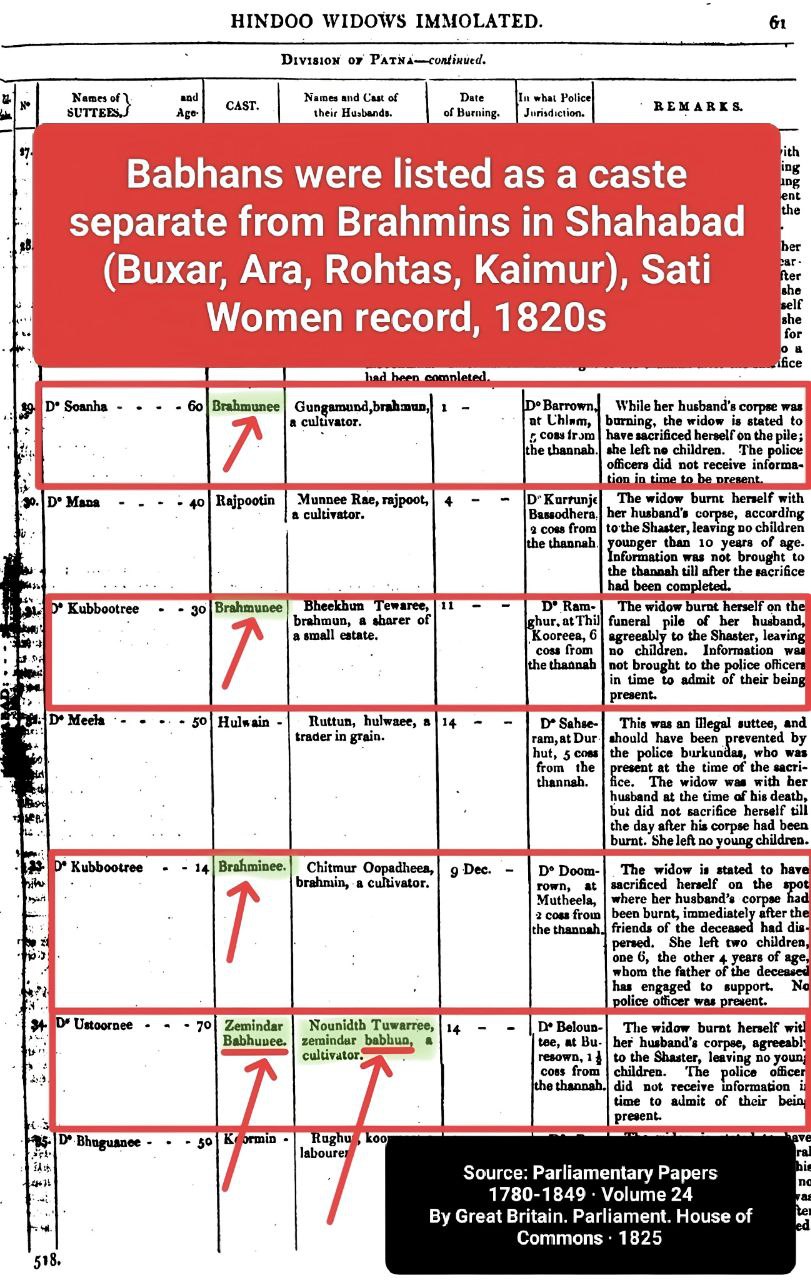
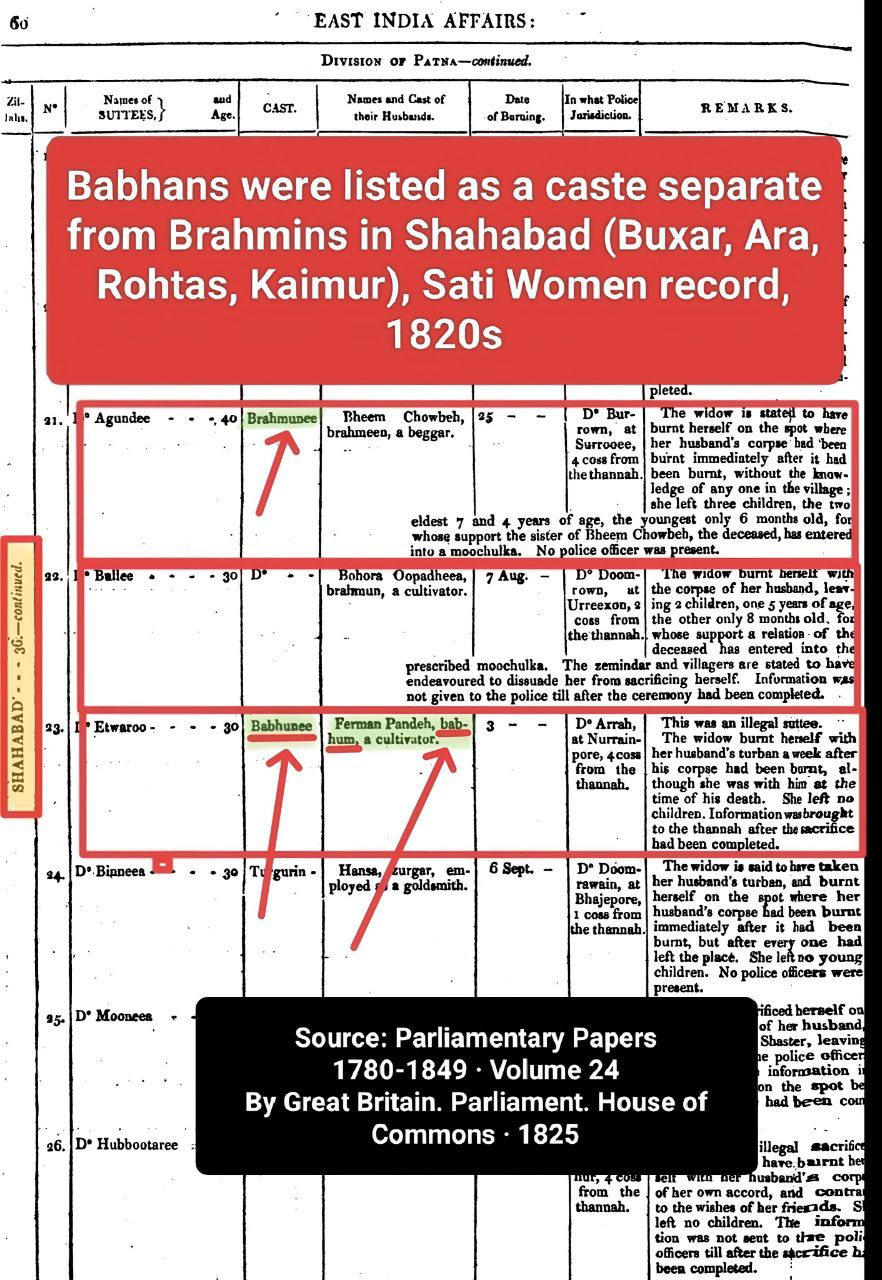
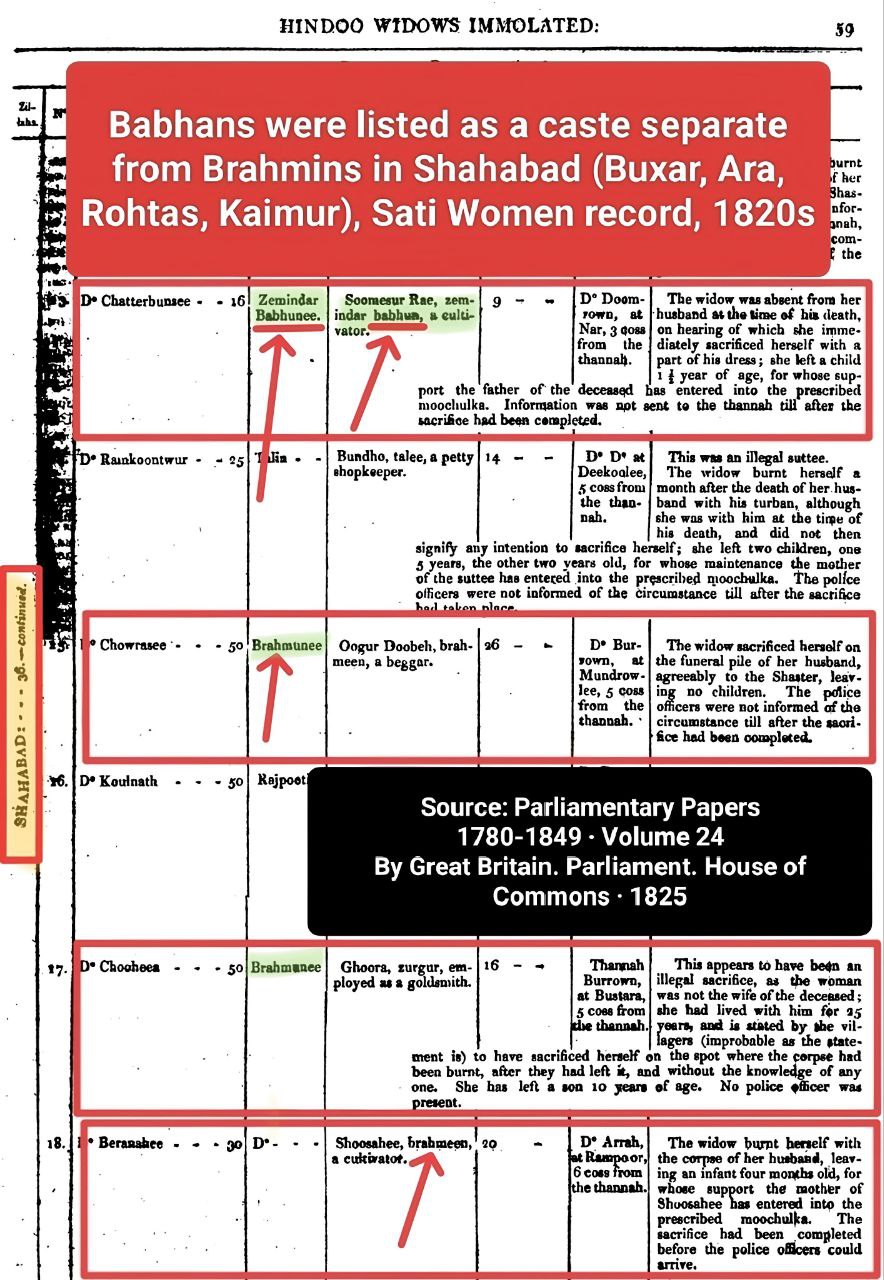
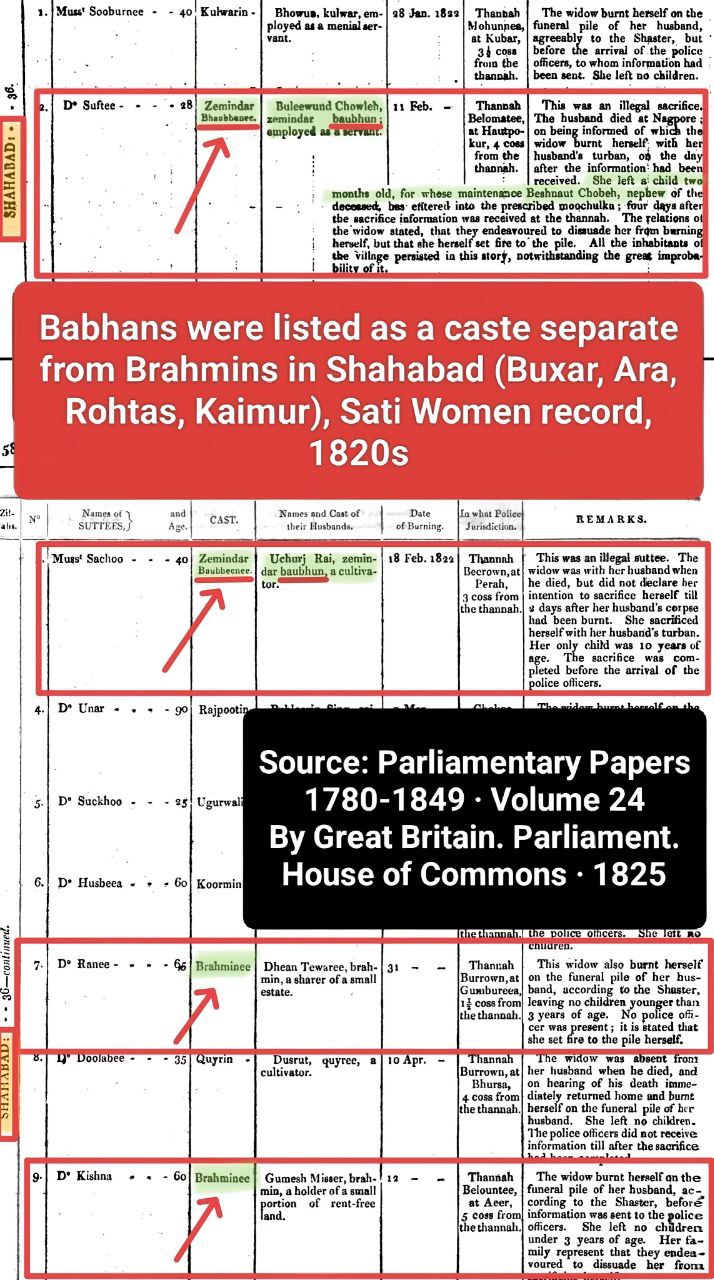
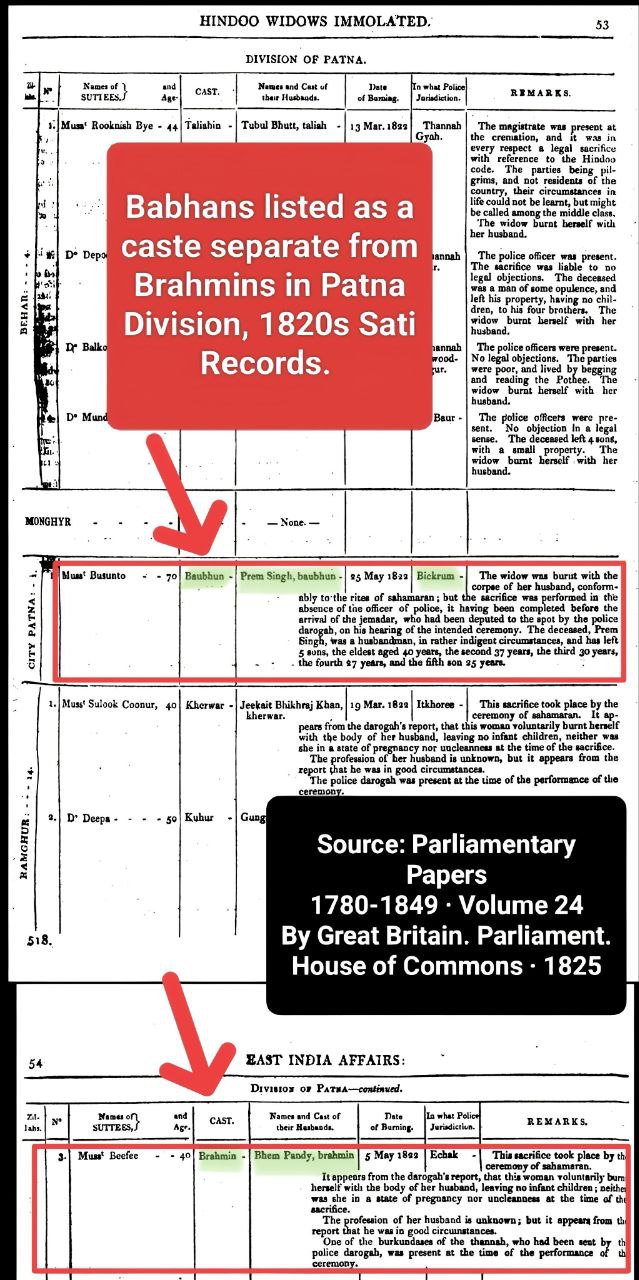
Some old records of traditional Brahminical surnames of Bhumihars going back to the 1750-60s

These Sati records from the 1820s contain details of women who committed sati, including their husbands’ names (Nounidh Tiwari, Ferman Pandey and Balwant Chaubey) and castes. Several Bhumihar women listed in these records bear Brahminical surnames and are noted to be between 40 and 70 years old.

This implies that their husbands, who also had Brahminical surnames, would have been of similar ages. If these individuals were using such surnames at an advanced age in the 1820s, this means they bore the same surnames at birth, and that goes back to 1750-60s.

Therefore, we know for sure that many Bhumihars hadn't dropped their Brahminical surnames even in the 1750s–1760s.

NOTE : Bhumihars are listed by their traditional name, 'Babhans' while the Brahmins are recorded just as Brahmins in these records.

Surname Record 1 Surname Record 2 Surname Record 3 Surname Record 4 Surname Record 5

References

ID Book/Article Author Year Snippet
[1] Lorem Ipsum