Characteristics
Community Overview
In this section, we will delve into a broad spectrum of observations, interpretations, and commentaries related to the general character and social position of the Bhumihar community. These insights span across different historical periods and originate from diverse sources, including British colonial officers, census writers, and ethnographers who documented caste identities and social hierarchies in their administrative records. Their writings often reflected not only their personal viewpoints but also the colonial understanding of Indian society, making them valuable yet sometimes biased references for understanding how Bhumihars were perceived during that era.
Alongside these colonial records, we also consider the perspectives of other Hindu castes, regional communities, and contemporary authors who have written extensively on social affairs, caste relations, and political dynamics. Scholars, journalists, and writers have offered varied interpretations of Bhumihar identity, touching upon aspects such as their cultural practices, political influence, landholding patterns, and social interactions. By compiling and analyzing these viewpoints, this section aims to present a balanced and comprehensive picture of how the Bhumihar community’s character and social standing have been described, debated, and understood across different periods and contexts.
2023 Caste Based Survey in Bihar
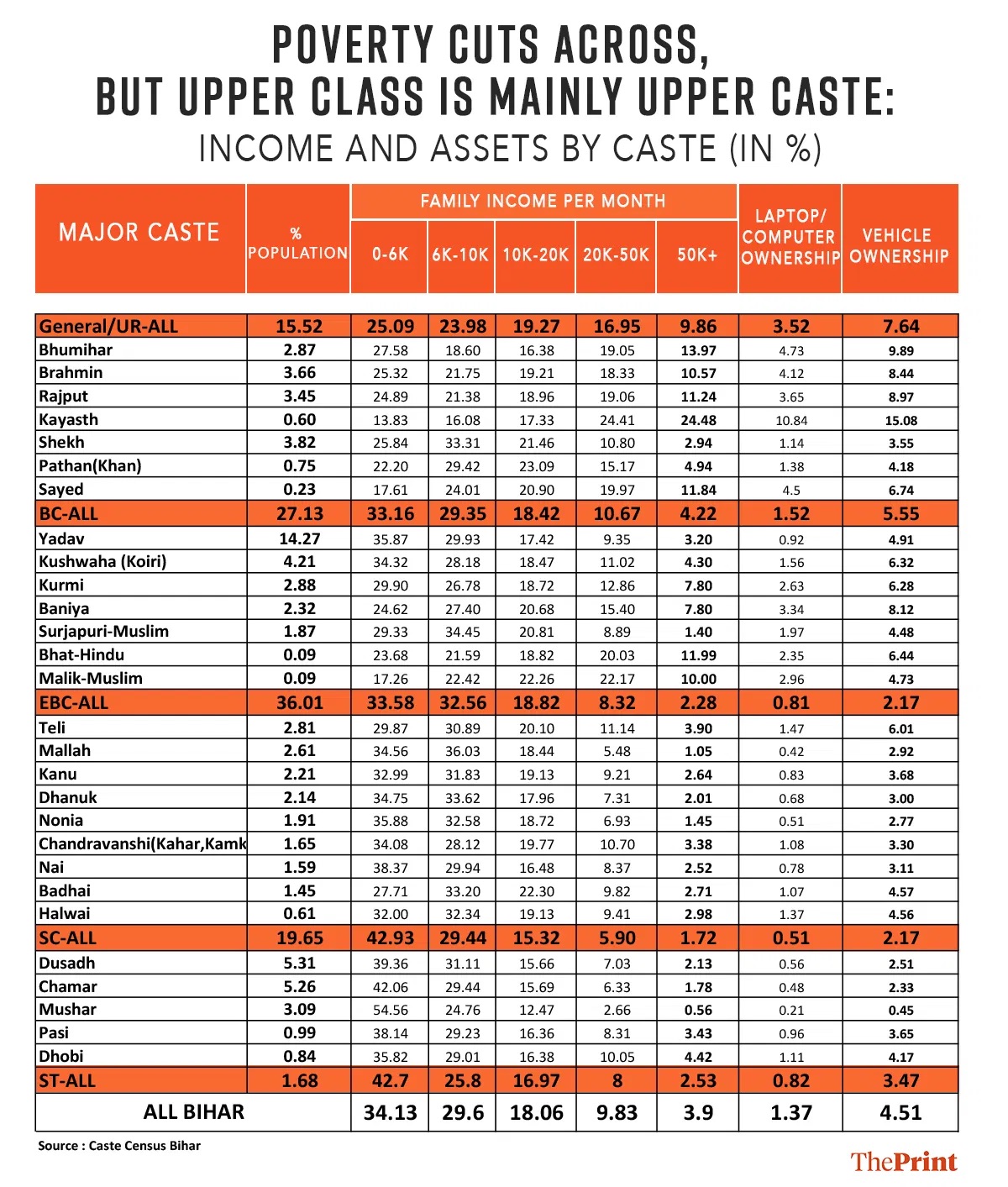
The Bihar caste–census data [1] 2023 Caste Based Survey Report in Bihar Go to References (Tables 1, 2 and 3) reveals a clear picture: Bhumihars stand among the top-performing castes in income, education, and organised-sector employment. In fact, on several indicators, Bhumihars perform better than many other upper-caste groups, including Brahmins and Rajputs.
1. Relatively High Income Levels
When we analyse the “50,000+ family income per month” category. Bhumihars consistently rank at the top within the General caste grouping, only behind Kayasthas.
Income (50k+ monthly):
- Kayastha: 24.48%
- Bhumihar: 13.97%
- Brahmin: 10.57%
- Rajput: 11.24%
This places Bhumihars firmly in the high-income bracket, well above most other castes in Bihar [2] Income & Assets by Caste Go to References
Bhumihars also show strong ownership of vehicles and computers, further confirming their asset advantage:
- Vehicle ownership: 9.89%
- Laptop/computer: 4.73%
These figures exceed Brahmins and Rajputs.
| MAJOR CASTE | % POPULATION | FAMILY INCOME PER MONTH | LAPTOP/ COMPUTER OWNERSHIP | VEHICLE OWNERSHIP | ||||
|---|---|---|---|---|---|---|---|---|
| 0-6K | 6K-10K | 10K-20K | 20K-50K | 50K+ | ||||
| GENERAL | 15.52 | 25.09 | 23.98 | 19.27 | 16.95 | 9.86 | 3.52 | 7.64 |
| Bhumihar | 2.87 | 27.58 | 18.60 | 16.38 | 19.05 | 13.97 | 4.73 | 9.89 |
| Brahmin | 3.66 | 25.32 | 21.75 | 19.21 | 18.33 | 10.57 | 4.12 | 8.44 |
| Rajput | 3.45 | 24.89 | 21.38 | 18.96 | 19.06 | 11.24 | 3.65 | 8.97 |
| Kayasth | 0.60 | 13.83 | 16.08 | 17.33 | 24.41 | 24.48 | 10.84 | 15.08 |
2. Educational Excellence — Higher Than Brahmins on Key Indicators
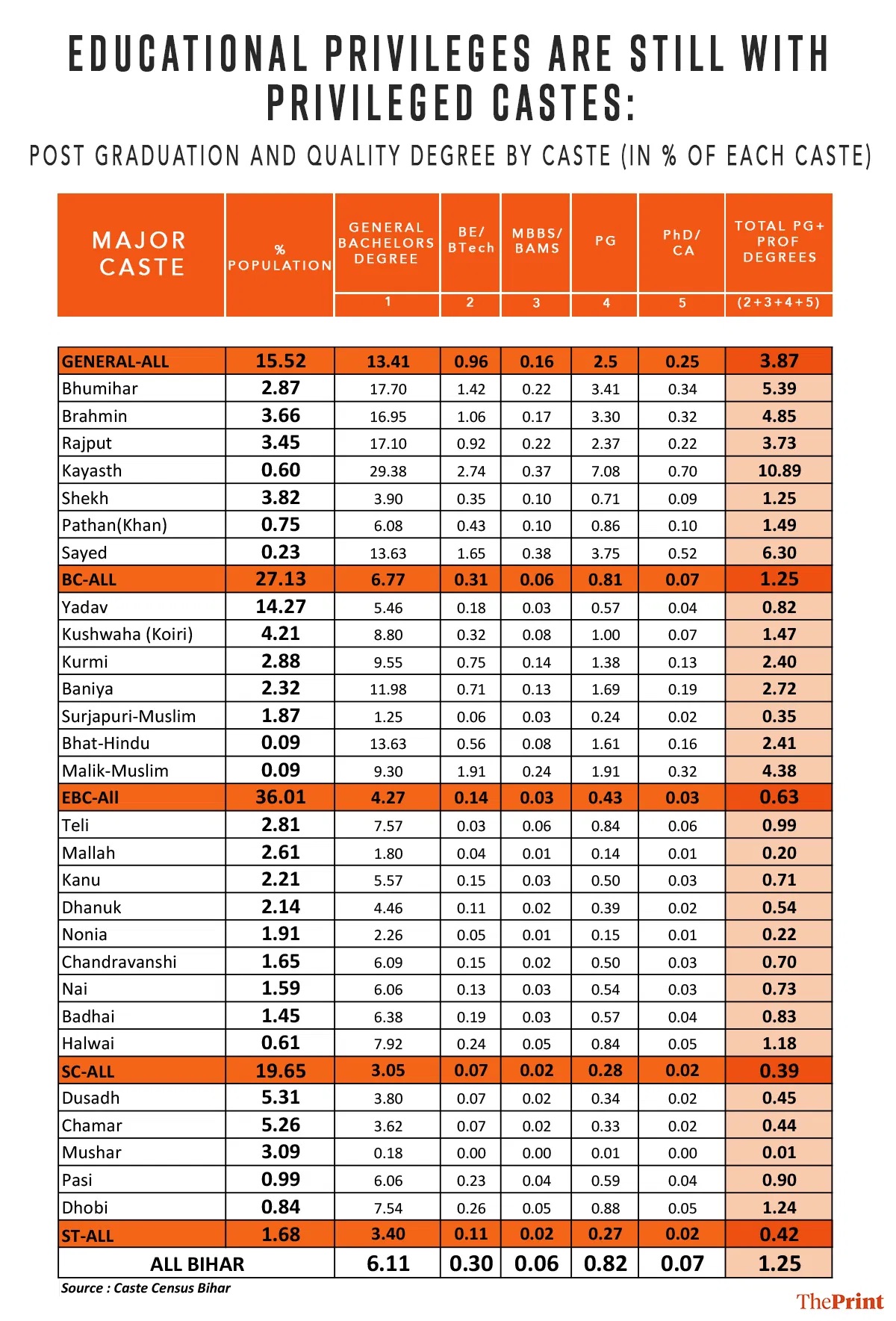
Education data shows that Bhumihars continue to maintain exceptionally high literacy and higher-education levels.
Total PG + Professional Degrees:
- Bhumihar: 5.39%
- Brahmin: 4.85%
- Rajput: 3.73%
This means that Bhumihars have a greater proportion of postgraduates, engineers, doctors, CAs, and PhD holders than Brahmins, making them one of Bihar’s most academically successful communities after Kayasthas [3] PG & Quality Degree by Caste Go to References
| MAJOR CASTE | % POPULATION | GENERAL BACHELORS DEGREE | BE/ BTech | MBBS/ BAMS | PG | PhD/ CA | TOTAL PG + PROF DEGREES |
|---|---|---|---|---|---|---|---|
| GENERAL | 15.52 | 13.41 | 0.96 | 0.16 | 2.5 | 0.25 | 3.87 |
| Bhumihar | 2.87 | 17.70 | 1.42 | 0.22 | 3.41 | 0.34 | 5.39 |
| Brahmin | 3.66 | 16.95 | 1.06 | 0.17 | 3.30 | 0.32 | 4.85 |
| Rajput | 3.45 | 17.10 | 0.92 | 0.22 | 2.37 | 0.22 | 3.73 |
| Kayasth | 0.60 | 29.38 | 2.74 | 0.37 | 7.08 | 0.70 | 10.89 |
3. Strong Footprint in Govt & Private Sector Jobs
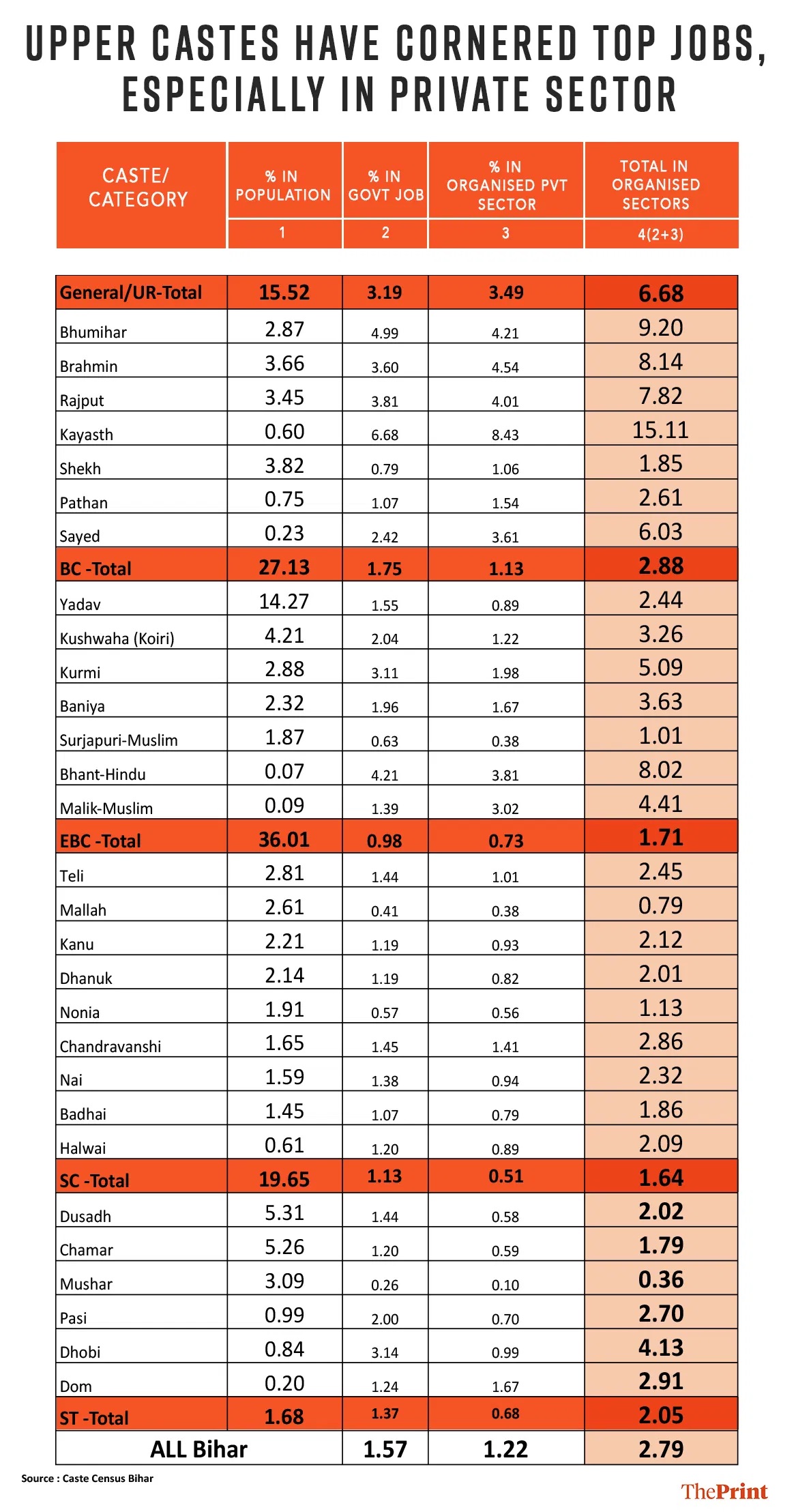
In organised-sector employment—including government and private salaried jobs—Bhumihars again appear near the top.
Government Jobs (% of caste population):
- Bhumihar: 4.99%
- Brahmin: 3.60%
- Rajput: 3.81%
Private Sector Jobs:
- Bhumihar: 4.21%
- Brahmin: 4.54%
- Rajput: 4.01%
Total in organised sector (Govt + Pvt):
- Bhumihar: 9.20%
- Brahmin: 8.14%
- Rajput: 7.82%
This makes Bhumihars one of the most dominant castes in high-quality salaried employment, clearly outperforming most others [4] Jobs in Pvt & Govt Sector Go to References
| CASTE/ CATEGORY | % IN POPULATION | % IN GOVT JOB | % IN ORGANISED PVT SECTOR | TOTAL IN ORGANISED SECTORS |
|---|---|---|---|---|
| GENERAL | 15.52 | 3.19 | 3.49 | 6.68 |
| Bhumihar | 2.87 | 4.99 | 4.21 | 9.20 |
| Brahmin | 3.66 | 3.60 | 4.54 | 8.14 |
| Rajput | 3.45 | 3.81 | 4.01 | 7.82 |
| Kayasth | 0.60 | 6.68 | 8.43 | 15.11 |
What This Means for the Community
The data demonstrates that:
- Bhumihars rank among the richest castes in Bihar: Only Kayasthas surpass them at the very top.
- They have an excellent educational profile: Higher percentage of PG/professional degrees than Brahmins or Rajputs.
- They are strong in both government and private sectors: With one of the highest organised-sector employment rates in the state.
Together, these indicators portray Bhumihars as a high-achieving, educated, economically stable, and professionally successful community, contributing significantly to Bihar’s skilled workforce, administration, and knowledge economy.
British Reports
John Beames of the Bengal Civil Service, Member of the German Oriental Society, of the Asiatic Societies of Paris and Bengal, and of the Philological Society of London wrote about the physical characteristics of Bhumihars with respect to their neighbours. He described Bhumihars as a fine manly race with delicate Aryan features who are not easily tamed.
Brits highlighted the extremely cohesive nature of Bhumihar society. When a Bhumihar was in trouble, other Bhumihars, even from faraway places, would come forward and vehemently oppose his sentencing if he was to be penalized. Wilton Oldham related an incident highlighting this nature of Bhumihars as follows:
I once had occasion to sentence to a short term of imprisonment a young man of a respectable Bhumihar family. A number of Bhumihars, of a different tribe, and from a distant part of the district, begged that his sentence might be commuted to a fine, as his imprisonment was a di-grace to their entiro community
British noted that Bhumihars were the only cultivators who didn't seek the protection of Kshatriyas or paid them any rent. Bhumihars were their own protectors. In the words of John Collinson Nesfield:
LSS O’ Malley writes about Bhumihars in the Patna Gazetteer in 1907 that Babhans (Bhumihars) are addicted to rioting, violent and very tough to control. In his words:
LSS O’ Malley in 1909 contrasted the Mongolian featured local aborigines of Monghyr division with the high-browed Aryan-featured Babhans, highlighting the Aryan features of the Babhans (Bhumihars) of Munger. He remarked:
Babhans of Monghyr are described by LSS O’ Malley the British officer as "Bold and having an overhearing character", and they tended to quickly mobilise for a cause, forming a brotherhood in no time, to combat any adversity. The British described this characteristic trait to be found in Bhumihars of Ghazipur as well. He said:
LSS O’ Malley the British officer noted in 1909, of all the castes in Monger Division, only Babhans were opposed to Vaccination, indicating a very rebellious and conservative character of Bhumihars of the region. He said:
The British officer Wilton Oldham and MA Sherring both observed that Donwar Bhumihars were more Aryan looking and had lighter skin complexion than Rajputs Donwars. Donwar is a common territorial section (Mool) between Rajputs and Bhumihars. They said:
MA Sherring’s Observation: In this district the Rajpoots aro quito distinct from the Bhumihar Donwars. The Donwar Rajpoots whom I have seen are of a dark complexion and have not Aryan features
William Wilson Hunter remarked about the Babhans (Bhumihars) of Magadha that they made good gang robbers, were very mischievous and fond of rioting. He said:
William Crooke, the British colonial officer and an ethnologist, highlighted about the low nasal index of Babhans (Bhumihars) and Brahmins, that Nasal Index (lower index means narrower nose and higher means wider) correlates strongly with the social standing of castes, considering how Bhumihars, an upper caste have the lowest Nasal Index in eastern India and Chamars and Musahars had the highest Nasal Index in that area. To quote him:
British officer Francis Buchanan reported in 1811 that the terror of Domkatar Bhumihars of Magadh was so severe that they were considered the leaders of anarchy and general public was so fearful that they were cautious of even talking about them, he said:
LSS O’ Malley described a peculiar situation involving Bhumihars, that even scientists may be oblivious of the disastrous and destructive results when Babhans serve as both landlords and tenants in the same village. They describe the situation as an instance of an irresistible force meeting an immovable object, and every attestation officer who's served in North Munger is familiar with this situation, he says:
Local Sayings
There’s a common saying about Bhumihars in Magadha that says that “Babhans, Dogs and Elephants all are ready combatants”, it goes like this:
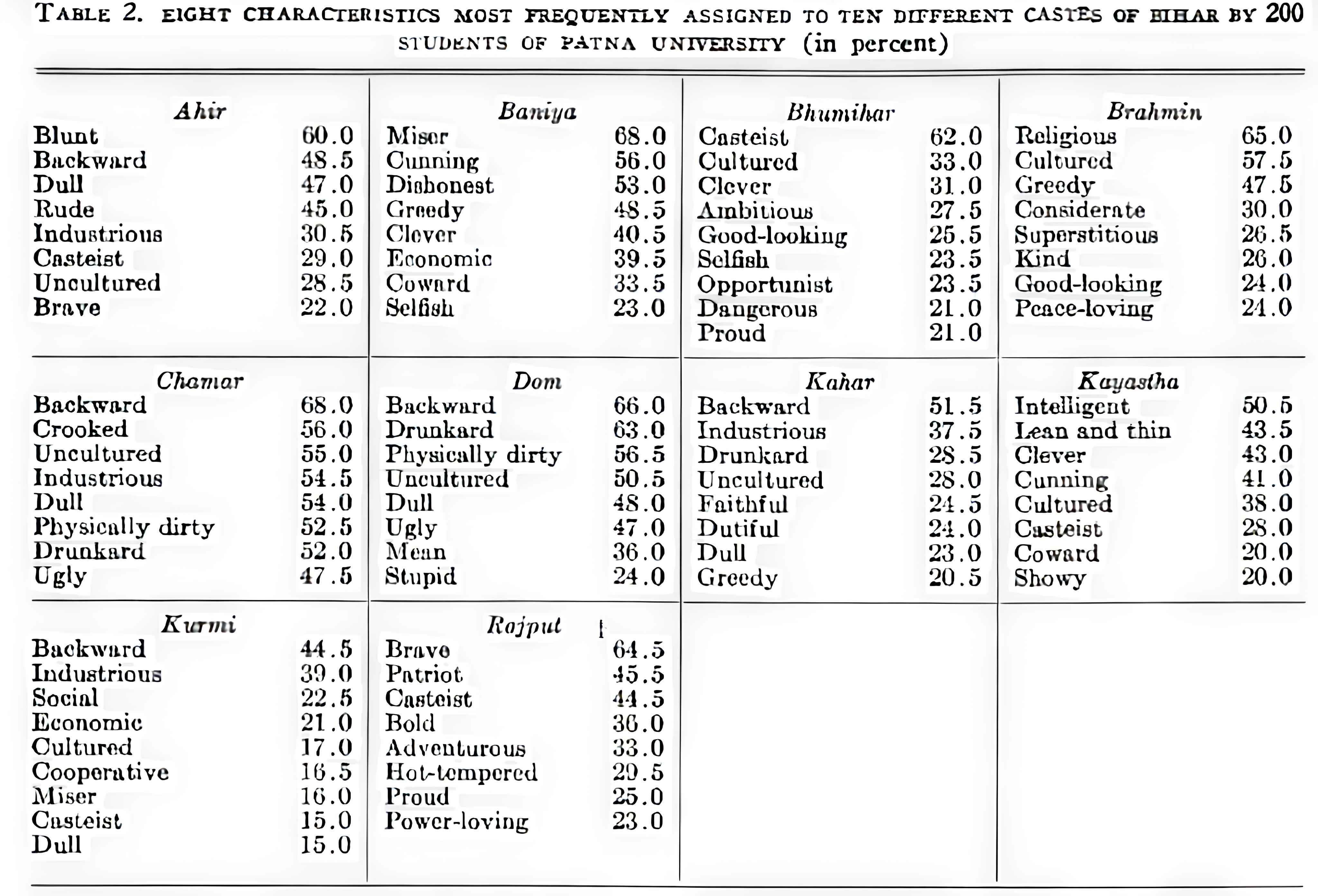
Survey of 200 Patna University students stereotyped different castes, with Bhumihars placed alongside nine other groups for comparison. For Bhumihars, the most frequently assigned traits were: casteist (62.0%), cultured (56.0%), clever (35.0%), ambitious (25.0%), good-looking (23.5%), selfish (23.5%), opportunist (23.5%), and dangerous (21.0%).
Kailash Bihari Lal in 1943 highlighted the dominance of Bhumihars in Bihar’s social landscape by bringing attention to the fact that how in a state so big, a numerically insignificant Bhumihars were one of two central power blocs that controlled the entire province’s politics. Bihar is depicted as divided into a “Bhumihar Zone” and a “Rajput Zone,” with all “minor” castes compelled to align with one of these two, which implies that Bhumihars (along with Rajputs) set the terms of political participation for others in Bihar. Kailash Bihari Lal says:
Nirod Mukerji highlights the animosity between the Rajputs and the Bhumihars of Bihar as:
Mark Tully remarks about Bhumihars in 1995 that they considered their pride above anything. He says: